
A Field in Saskatchewan: Four Stories West of Wolsley
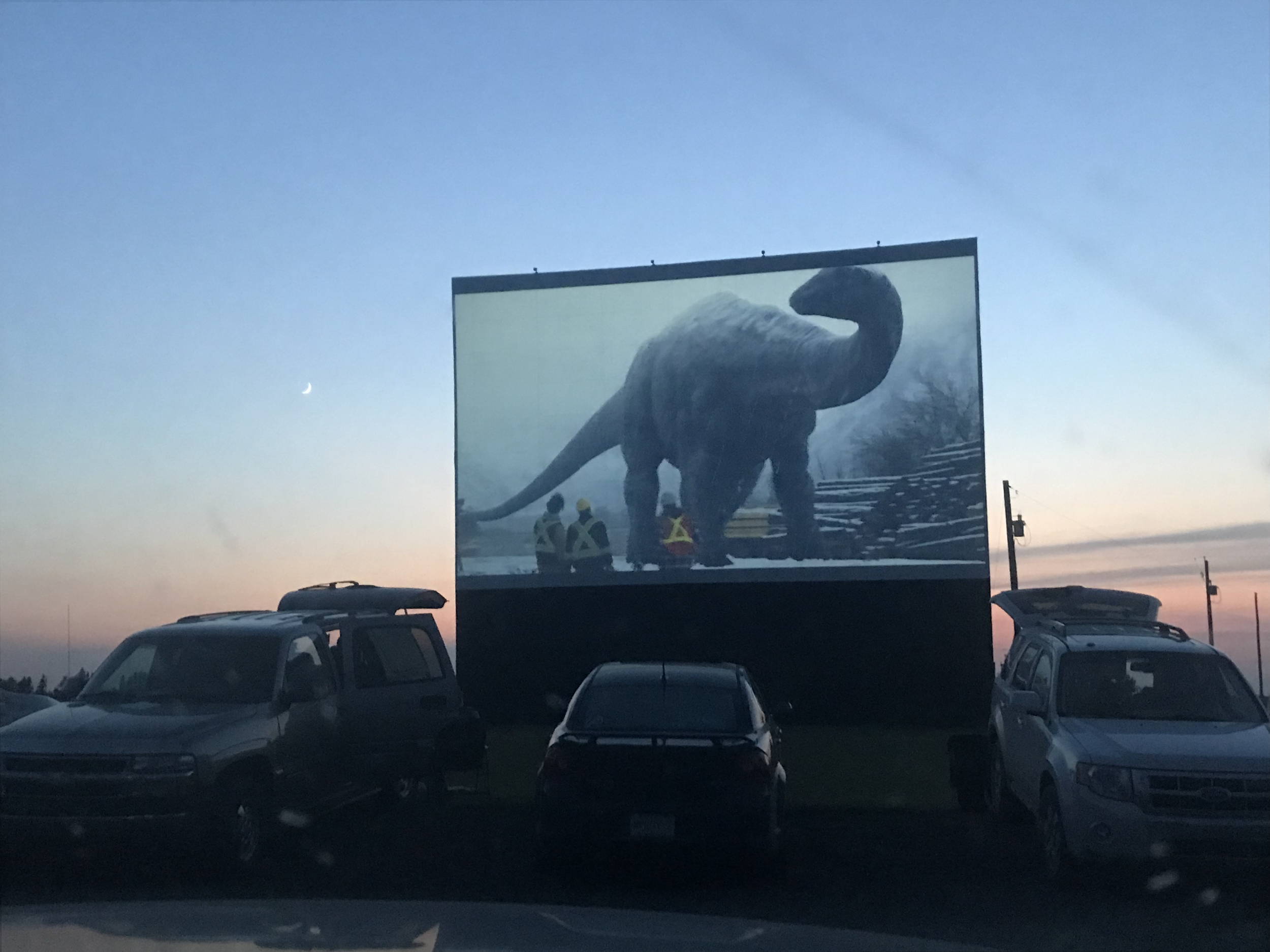
Drive-in at Twilite (Colton Bates, 2022)
“There he goes. One of God's own prototypes. A high-powered mutant of some kind never even considered for mass production. Too weird to live, and too rare to die.” – Hunter S. Thompson Fear and Loathing in Las Vegas (1971)
On the dusty plains of Saskatchewan the autumn air filters sunlight like the smokey celluloid of a family film putting an amber hue on everything. This golden hour can last all day, but sunset adds layers to the experience; the shadows of plants grow long, birds return to their nests, crickets share their tunes and spiders spin their webs. All approachable horizons surround me and I am thinking about drive-in cinemas.
2022, July 1
West of Wolseley, an audience of Explorers and Rangers, Pathfinders and Highlanders, Kia Souls and Teslas has assembled. These vehicles of archetypal expression are arranged like the letters of a keyboard in front of the three-storey screen of the Twilite Drive-in theatre. My friend Rex and I are in his Mazda 3 with his fiancée, Rena, and her friend Nat. We are all gathered to witness the resurrection of the dinosaurs in Colin Trevorrow’s Jurassic World Dominion – also, it’s Canada Day.
Rex has just returned from Europe, where he, Rena and Nat were participating in humanitarian efforts related to the war in Ukraine. This is Nat and Rena’s first experience of Canada and Rex and I are trying to share some unique aspects of our culture with them. Caesars and poutine at the Katepwa Beach Hotel did not go over well. Everyone ordered pizza instead. Now we are watching a terrible movie, full of all the nonsense one would expect from an ensemble cast that includes dinosaurs. I am thinking about the outdated dinosaur that is the “drive-in” industry, the fossil fuels powering the engines in most of the vehicles gathered here, and the dinosaur in my friend's name. I cannot find anything particularly Canadian about the experience.
To Rex and I, the cultural connection is obvious. We were both raised on the cinema of the Canadian North. We have shared experiences of movies, miracles, and movie miracles, not to mention the work we have done together on moving-image media projects; collaborating on photoshoots and film productions. As I am thinking, the circumstances surrounding one of our photoshoots spring to mind:

Hemp Field at Night (Rex Leniczek & Colton Bates, 2019)
2019, August 27
South of Lemberg, Rex operates an organic farm alongside his father Chuck. Tonight they are out, standing in their crop of hemp. This is the second time I have seen hemp attempted within the borders of Saskatchewan, but it’s the first time I have been invited on a crop tour. In Ontario I lived with some producers for a while, but their crops could never compare to what I am looking at here. I’m looking at acres of bud. My neighbours are looking for germination, maturity and quality. Unfortunately for this crop, Lemburg has had a dry year, germination is low, and without precipitation in the forecast, what is growing will not reach maturity. Altogether, the crop is a disappointment and the only thing to be done is decide when to cultivate.
In other geographies with warmer climates and broader growing seasons, producers might plough, replant and irrigate. Here in Saskatchewan we plant and we pray for the proper weather conditions. When they cooperate, we harvest. When they don’t, we cultivate, by scuffling the dirt and tilling the soil to return the nutrients of an unsuccessful crop to the earth. Because Chuck and Rex are organic producers, cultivation is their only option if they are going to hold out hope for hemp next year. It’s a practice of soil-conservation. Something has to be growing in this field before next summer, otherwise wind will carry the soil that isn’t held in place by the roots of growing plants and the effects of drought will get more serious. In the meantime, this crop is standing dead, the sun has set and the stars are shedding their light.
Silhouetted above the coulee we are standing in, Chuck’s truck seems to have taken on a new shape. Inside the ‘88 Chevy S15 my suspicions are confirmed when reflections of light on Chuck’s face draw my attention to the instrument cluster. There I see all the hallmarks of a cyberpunk aircraft: Eurostile typeface, moonphase fuel metre, automatic transmission, an odometer reading that represents the distance of a one way trip to the Moon, and it is all backlit in blue. More miraculous than the beauty of the instrument cluster is the fact that most of the gauges are working. This is no ordinary farm truck, this is an interplanetary starship.
For a brief moment on our trip to the farmyard, we are a team of planetary ecologists, we are returning home with reports from our travels and in those reports our outer space crops are going to work out. As we approach the lights of the farmyard, however, the fantasy fades. Fieldwork is complete for the day; cultivation will begin tomorrow.
Back in 2022, the people of Earth, including Nat and Rena, have their own fantasies and traumas. I don’t expect that they have any knowledge of our experiences with Saskatchewan’s agricultural industry. I only wish Rex and I were sharing the results of one of our projects on the big screen. One abandoned production from 2021 would have made a decent feature in the atmosphere of 2022:
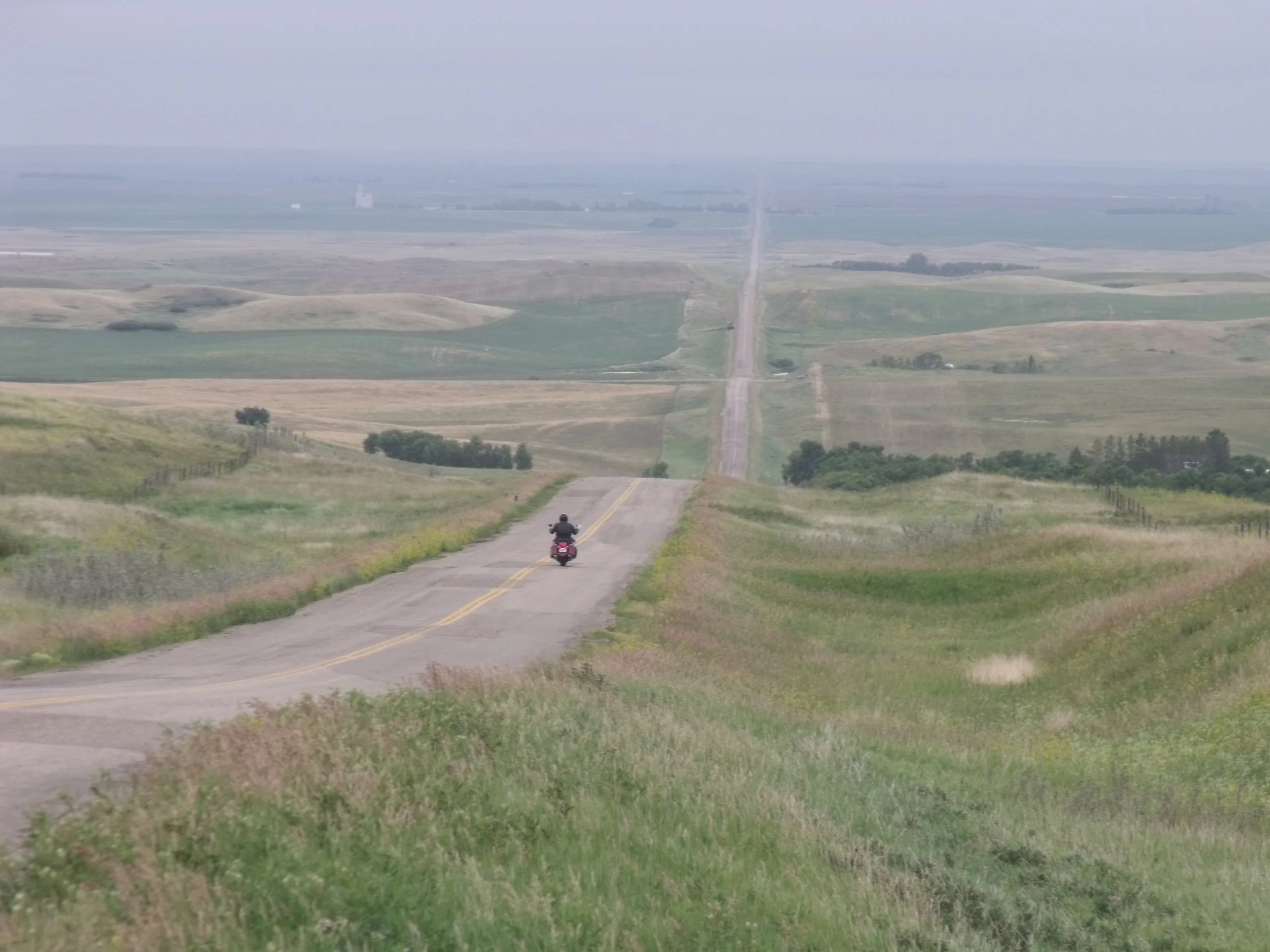
Southbound Rider (Colton Bates, 2014)
2021, August 29
East of Abernethy, Rex and I are out under the morning sky, sitting at a picnic table in the campground where I live. A couple of baseball diamonds separate us from the prairie scenery that unfolds as far as the eye can see. Rex is working on a film script; I am advising. This is only the second time I have participated in a film production within the borders of Saskatchewan. My first production with Rex wrapped before Father’s Day in 2020. Today’s project is a narrative fiction about farming.
My memory has erased the script’s finer details, but I can remember one scene where a character is standing in their yard, watching their friend mount a motorbike and ride away. It is an image which, in my mind, symbolizes the exodus of Saskatchewan’s film industry. Nearly ten years after the loss of Saskatchewan’s film employment tax credit, Rex has drafted a narrative that captures the psychology of that loss with a visual allegory. I am excited by the script, but I cannot help thinking that without institutional backing our production has no more chance of success than 2019’s hemp crop. Sometime after that I am standing in my yard, watching Rex mount his motorbike and ride away. The script gets abandoned; Rex leaves the province; I work on my writing.
As I am revisiting these memories in the awkward atmosphere of the Wolseley drive-in, Nat, Rena, Rex and I are visited by some of the most unpredictable weather patterns. Through the windows of the car we see the space around the three-storey screen ignite with light. The four of us exit the vehicle and step into the aurora borealis.
Present
Following the setting sun, the relative stillness of the North Star arrests my attention and the rotation of the Earth becomes detectable in the orbits of the astrological archetypes. The fantasy of a fully functioning instrument cluster distracts me from poor crop germination, unforgiving commodity markets, and the unpredictable weather patterns of Saskatchewan. More than that, I am comforted by the fact that, of all the provinces in the Canadian North, Saskatchewan is not a flyover province. Saskatchewan is home to the last best drive-ins in North America. Wolseley has one. Manitou, Creighton and Pilot Butte have screens. Now we need to fill them with prairie productions. With the northern lights on our side we cannot do worse than Jurassic World Dominion.