
A Short History of the Saskatchewan Filmpool and Splice Magazine
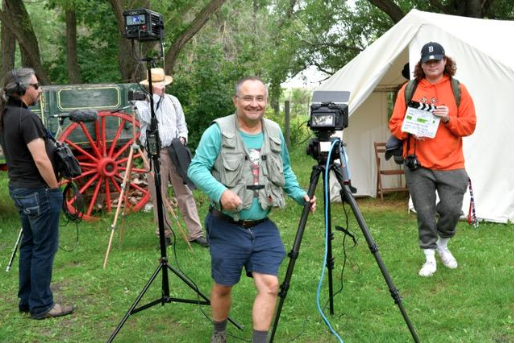
Don List (centre) on set at Motherwell Homestead National Historic Site, located just south of Abernathy, Saskatchewan. He was there shooting a project in August. 2022.
Photo by Calvin Fehr
In August 2023, writer Sandra Staples had the opportunity to spend some time and speak with Saskatchewan Filmpool Co-Founder, Don List. During that conversation, Staples learned quite a bit about the early days and origins of the Filmpool. Unfortunately, this is but a brief history, but one we at Splice will hope you enjoy.
Born in Regina, Don List originally followed his interest in social studies and politics and started his first year of the Master of Social Studies at the Regina Campus of the University of Saskatchewan. During a conversation with his professor Stan Rantz, List was encouraged to pursue his interest in film. That pursuit led List to become one of the founding members of the Saskatchewan Filmpool Cooperative.
In the seventies, film was all the rage across Canada with the emergence of various filmmakers societies and cooperatives in Ontario, Manitoba, and British Columbia. However, the film industry didn’t gain momentum as quickly in Saskatchewan. In Regina, there were two early film companies, both run by husband and wife teams. The Cherrys worked on commission, creating documentaries of the times, while the recently retired Birds concentrated on wildlife documentaries. Other than those two early companies, there wasn’t much else for film business happening in the province, and, at that time, the Saskatchewan government outsourced their public service advertising to firms outside the province.
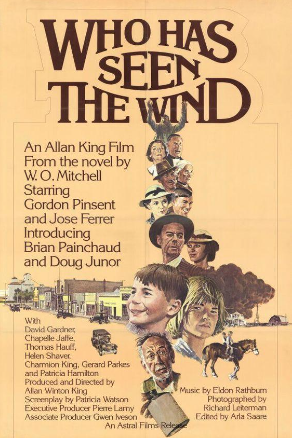
The poster for the 1977 film Who Has Seen the Wind, based on the book by Canadian writer W.O. MItchell. The production of the film was a catalyst for creating the Saskatchewan Filmpool.
List explained that, in an effort to improve this situation, the University of Regina worked with the provincial government’s Department of Youth and Culture to bring filmmakers Allan King and Patricia Watson to the province to create a film as training for local filmmakers. The resulting film, Who Has Seen the Wind, was shot in Arcola, a small town in south-east Saskatchewan. It was on this project that the founders of the Saskatchewan Filmpool bonded and the seeds were sown for what would eventually become the Saskatchewan Filmpool Co-operative service agency.
List, Gerry Horne, Bill Mills, Ian Preston, Charles Konowal, and Brock Stevens were already getting together to discuss their work and conditions for filmmakers in Saskatchewan. They brainstormed, worked, and socialized. They connected with emerging film societies, the Canada Council for the Arts, and the Saskatchewan Arts Board and they attended conferences and film festivals like the Yorkton Film Festival, learning everything they could to create a more accessible climate for them to make films in Saskatchewan.
Around the same time, the Regina Campus of the University of Saskatchewan hired Terence (Terry) Marner to teach film. I was fortunate enough to interview Marner in spring 2024 about one of his films and he shared about the development of the Film Department at the University in Regina. When he was hired, no one was teaching film in the Fine Arts Department. During his time, he invited various guest lecturers to supplement his class while he returned to England to get his master's in film studies. One such guest, Jean Oser, was given a position on staff as his concentration on production rounded out the film instruction in the Department of Fine Arts at the Regina Campus of the University of Saskatchewan.
List says it was Francois Picard from the Canada Council who encouraged the development of the Saskatchewan group. There was a feasibility study contracted by the provincial government and the group of filmmakers registered as a service co-op in 1977.
One barrier for filmmakers was that buying equipment was very expensive and not available to rent locally. It had to be rented and shipped from Toronto, Montreal, Vancouver, or, occasionally, Winnipeg. The focus of the Filmpool was to set up an equipment pool, where filmmakers could easily rent equipment that would otherwise be too expensive or time-consuming to order from out-of-province sources.
With a grant from one of their arts funders, the co-op began to purchase cameras, microphones and other filmmaking equipment. One of the first pieces of equipment that Filmpool purchased was a Steenbeck, a flatbed editing suit, purchased with a grant from Sask. Sports and the Department of Culture and Youth. The logic behind this was to enable local filmmakers to document and edit footage of sports events in Saskatchewan and have them delivered more quickly and with less cost than bringing someone in from out-of-province. This was pre-digital filmmaking and the Steenbeck flatbed was the apparatus used for editing analogue film by cutting and pasting, or splicing, the film.
The new cooperative set up an office in the old Northern Crown Building in Regina, which also housed a couple of bands and an independent artist. The Filmpool covered the insurance and liability requirements and although they could not produce film, they could provide filmmaking workshops and host visiting artists. Members made some of their first films in these workshops. Some of the films from the early workshop days were Angelos Hatzitolios’ Hunting Excursion, Elmer Nakamura’s Firehall Number 2, and the one that List says got the most mileage was Joanne Reilly’s film, Prairie Motorcycle, which was about the time she became executive director of the Filmpool.
Due to the nature of how they were registered, the Filmpool could not produce its own films. However, as they were working on the production of Folks Call Me Tommy, the group realized they could create a for-production co-op, which resulted in the creation of Birdsong Film Production Co-op.
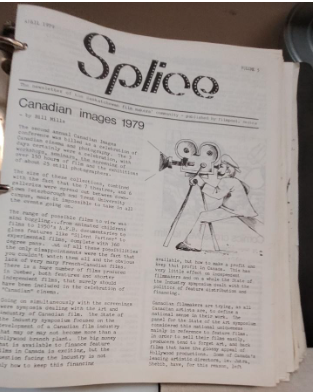
A copy of the first issue of the Splice newsletter, which was published in 1979.
One of the funding agencies suggested that as a service agency, it was important to have a newsletter. Fortunately, Horne had knowledge of such things as he was the publisher and editor of the University paper, Insight. So, they put together a newsletter and the first issue went out in April 1978. The newsletter, Splice, had information on members’ projects, workshops, Canadian Film conferences and events (especially the Yorkton Film Festival), and even about Evelyn Cherry, the documentarian from Regina, who prided herself in being able to make a living on her film work without the help of government grants. The artist who shared the building drew sketches for the front cover and there was comraderie amongst the creative community renting space in the building.
Just as the Filmpool evolved over the years, so did its newsletter. Some of the founding members’ careers took off and as they started doing profitable work, they began moving away and became more commercial, a natural stage in their careers. In the eighties, List felt it was time to pass the torch on to the new wave of film students starting out their careers.
Members of that new group of filmmakers included Gerald Saul, Mark LaFoy, Brian Stockton, Elaine Pain, Valerie Loyd, Rosalee Bellefontaine, and Claudia Stone.
List felt that Saul was responsible for upgrading Splice to the look of a more professional-looking magazine, and included advertising from local businesses as well as the news from local and Canadian filmmakers.
With my hometown being Saskatoon, I was curious about the friendly rivalry between the two largest Saskatchewan cities. List said that this was the Saskatchewan Filmpool and in the early eighties some members moved to Saskatoon, including one of the founding members, Ian Preston. Carmen Milenkovic and Ian Reid had the idea of setting up a satellite office in Saskatoon, which sadly didn’t last.

Copy of the 20th anniversary issue of Splice.
When I asked Saul about Splice, he wrote, “The people who worked to improve Splice the most were Robin Schlaht and John Kennedy. Editors were traditionally also the Secretary on the Filmpool Board, which is an elected position.” At the time, Filmpool also had a working board.
I asked past executive director Gordon Pepper when the Filmpool started hiring paid editors and it was soon after he started, around 2009. When I had my first article published in Splice in the Fall/Winter 2020 issue, it was a very professional magazine that included paid advertising and was distributed to various arts agencies and co-ops. Today, Splice and the Filmpool have started a new chapter. The most recent edition of Splice was the Spring 2023 issue, which was distributed in the online weekly newsletter.
2026-05-22 — Editor’s Note: Updated spelling of names throughout. Many thanks to Gerald Saul for the additional edits. -Mattias