
Fear & Trembling In Moose Jaw
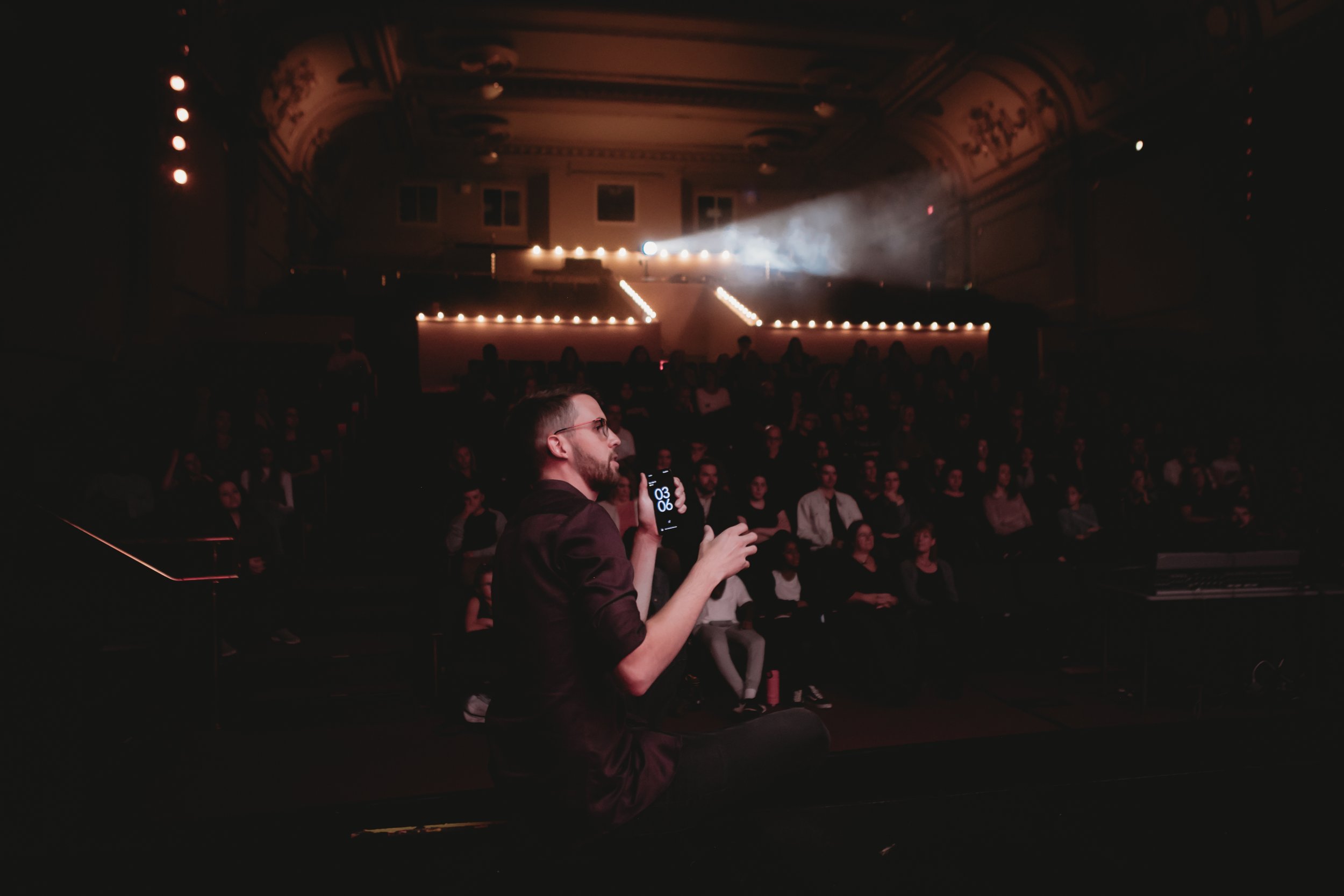
Jeremy Ratzlaff directs the audience. Photo: Jen Froese
Saskatchewan Filmpool member Jeremy Ratzlaff grew up in an evangelical, Mennonite household in Brandon, MB. After a brief stint in Lethbridge, AB as a young adult, he moved to Moose Jaw for a job, as a performer at the Tunnels of Moose Jaw, and calls the city home to this day. His work as a cinematographer is well known in the contemporary Saskatchewan filmmaking community, most recently as a cinematographer on Treaty Road (3 Story Pictures, Blue Hill Productions; in post-production), and he has been a Filmpool member since 2014. His latest short film, Fear & Trembling (2023), continues his “Faith Trilogy” and this past November the film won two Saskatchewan Independent Film Awards (SIFAs): Technical Achievement, and Best Performance for Maggie Robertson’s turn as stage director experiencing a crisis of faith.
But before all that went down, SPLICE had the opportunity to sit down with Ratzlaff the Friday before SIFA in November in order to learn more about his career, aspirations for Saskatchewan film, and how to manifest a crisis of faith on screen.
Can you talk a little bit about the trajectory of your career so far? You've been especially in demand as a director of photography. How’d you get here?
Director of photography is fun. Cinematography is one of the most collaborative positions that I've experienced, and great joy comes from working with directors on their visions.
I [got my start] working with artists, paying attention to artists and admiring artists working in a bunch of different mediums. Then when I was 21 [in 2015], I had this idea for a little series of videos, very informally structured, and I just wanted to make it with the immediate artists that I had around me. Berny Hi, I remember, was one of the first people that invited me to come and kind of do whatever it was, it didn't have a structure, I just wanted to, like, play around with some camera techniques and craft a story that really elevated the artist in a kind of a spotlight. I was calling them spotlights, tiny little videos, initially was just b-roll set to music, and then I involved some sort of more formal talking head set up stuff just to get these artists' stories [out there].
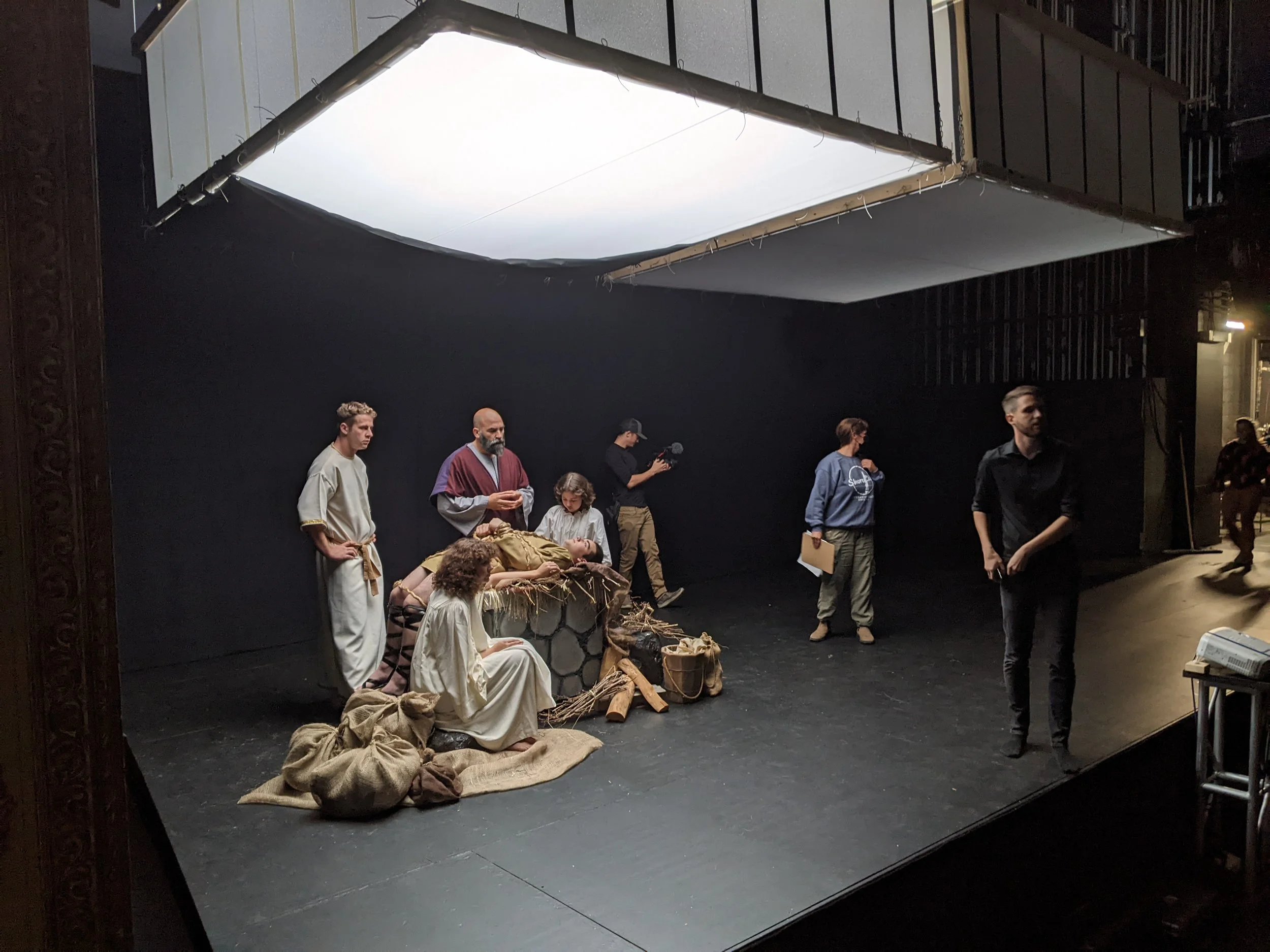
Lighting the stage. Source: Jeremy Ratzlaff
I was looking to explore the baton, the flame that gets passed from one artist to another, and kind of track inspiration. I was feeling super inspired as we were making this and I wanted to build on a philosophy of how creativity and inspiration worked. I worked with, I think, seven artists, just super local to me, in Moose Jaw, and Regina. Then Berny [Hi], someone hit him up from CBC. These producers were starting a new show for a new branch of CBC, CBC Arts, a flagship show that was gonna go to broadcast called the Exhibitionists. And they were like, "Hey, we're looking for these little vignettes of artists, and we're commissioning local filmmakers across Canada to get local stories." And Berny was like, “I think this guy's doing this exact thing already.” I had an experience that I'm sure will never be replicated again, where I remember sending them links and handing them what I had already built. And they bought them, no edits required, they fit the mold perfectly for their show.
Yeah, the dream.
After that, I did a lot more. I ended up doing, I think, eleven pieces for them. They linked me up with Adam Agoyan, Zachary Logan… that was the time. It was just beautiful. From that, I started getting opportunities to work with the Mackenzie Art Gallery and other art galleries. That's what I'm editing right now, is a Mackenzie Art Gallery video. Those are Zen: just the opportunity to go into those spaces and use the techniques that I've learned about and developed and gotten experience and to spotlight and elevate the work of artists and creativity. Of course, that quickly becomes short films and people's creative stories. Then I met the film community and that's the inspiration for all of it.
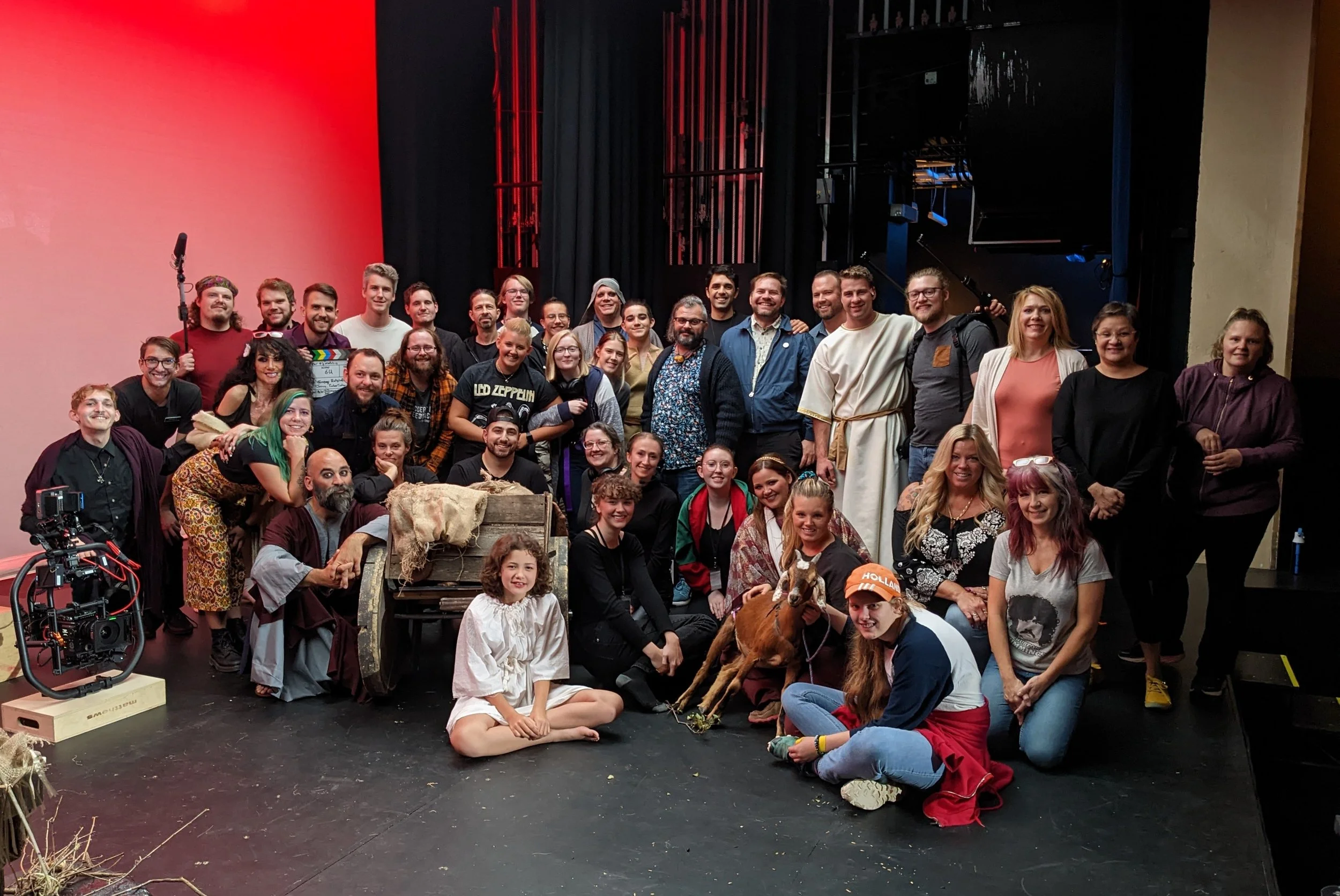
Cast and crew of Fear & Trembling. Source: Jeremy Ratzlaff
When did you join the Filmpool?
Oh, instantly. 2014 I think. I just Googled "Saskatchewan film" because I just moved here. I remember trying to find a place to park and trying to figure out Scarth Street for the first time because I'd never been in that area. Then walking in and [I] met Gord [past Executive Director] and Berny [past Production Coordinator). Gord was so welcoming, and he instantly made the entire place, and just the Sask film community, feel like the warmest thing in the world. I remember doing little tiny short films and getting advice from Berny and renting C-stands and using C-stands for the first time from the Filmpool in 2014.
Tell me a little bit more about the genesis for Fear & Trembling. What inspired you?
I took the faith structure that I was raised in very, very seriously. I remember pretty early on realizing that belief structure, the concept of faith that I'm becoming familiar with, needs to either be deeply personal or not exist at all. There's this realization that this concept that I was growing to understand about religious faith was one that had to be a deeply personally realized one, and a discipline and engagement. It wasn't just something that you could be a part of in a collective, floaty way. When I was 18, I started reading this guy named Søren Kierkegaard. He was a philosopher, father of existentialism, Danish, in the 1800s. And that was his whole thing. I'm not well versed in philosophy at all, but he had this kind of angst and frustration that he would express about the state church in Denmark at the time. I felt it, for some reason, and was connecting with his ideas that eventually became popular today, like when people talk about existentialism, [they’re going] back to some of Kierkegaard’s writings and his ideas on what it means to kind of live that. That life of choosing for yourself, your faith, path, your worldview.
So [Kierkegaard] has a book called Fear and Trembling, and the intro to this book is the retelling of the story of the binding from the Old Testament in the Bible. He writes it from Abraham's perspective, exploring three different ways that this Old Testament story might have actually felt to these characters. Because a lot of these Old Testament stories are very objective: this is what happened [rather than exploring the characters as characters]. This story was messing with Kierkegaard and he was like, “What is happening?” He's either a madman, this figure in religious history, who's going to kill his son like, commit, murder, infanticide, either he's a madman or he's so fully realized “faith” that he's this “knight of faith.” And that was kind of the crux of what he used to then further explore and think about what it actually meant to have a religious faith and be fully committed to it.
So the that's kind of what I found a slightly lighter hearted, tongue in cheek way to explore with a world that felt familiar to the evangelical church world that I grew up in where my dad was creative arts pastor who actually directed plays in big theatres, but they were all Bible plays and stuff like that.
That was going to be my next question: why the theatre? And what is your relationship to that? Because it's quite a dramatic turn in the film with the protagonist, I mean, not just breaking the fourth wall, but fully transgressing it in an improvised moment where she becomes the voice of God and the play becomes an opportunity for her own sermon decrying the audience members who are members of her community. Kierkegaard was working with novelization, is theatre now your medium to reconstitute this story?
I like theatre and the idea of working with actors, because a lot of the Saskatchewan actors I've worked with and really come to love and enjoy continuing to work with are from theatre, and I think theatre is more magical for actors. At least I always check with actors that I'm working with and ask them and usually they have to admit that theatre is more magical. So I was like, "Oh, to do theatre inside of film would be kind of fun.” I truly do think theatre is more magical than film. Film just sort of reaches to grasp at some of the magic that theatre has. That's my own personal feeling. I know film has its own things and is a different medium. But that's how I feel about theatre.
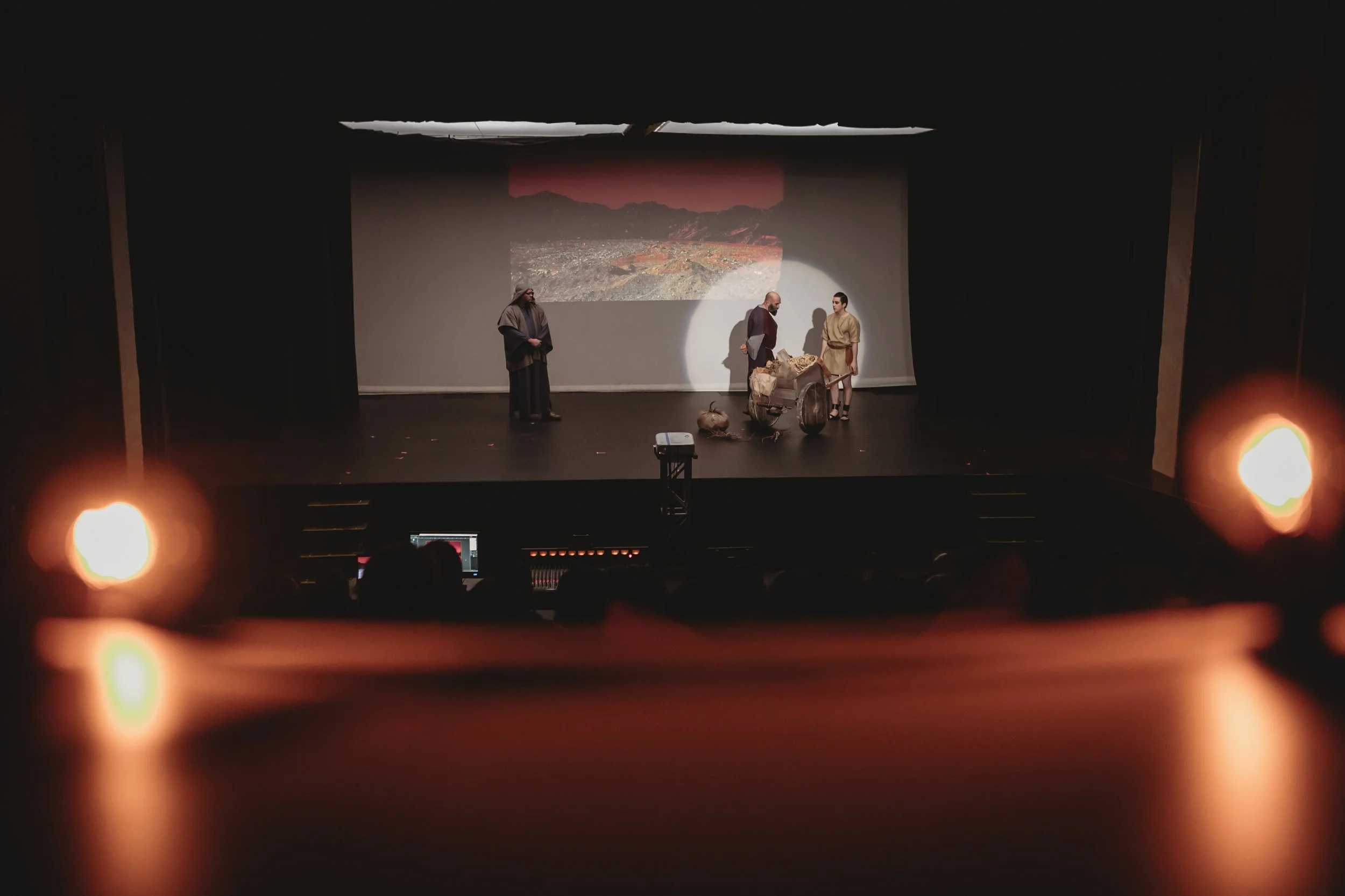
The drama of a dress rehearsal. Photo: Jen Froese
Can you talk about the casting process? Maggie Robertson's turn as your protagonist is quite a stunning bit of casting.
Award winning actress Maggie Robertson is from Yorkton. The first film that she auditioned for was the first film in my little faith trilogy [BY FAITH, DENIS (2021)] that I told myself I'd make when I was 18. It was a much smaller film, which was just kind of an awkward little Bible study, a 2021 COVID film. She plays this character who is soft spoken in the film, quiet, and then you realize that she's experiencing hurt when topics of sensitive topics are raised in sort of an insensitive way, in this context of this group by this pastor. And just in her minor performance, there was so much subtlety and brilliance in her and I was like, holy. I immediately started recommending her to fellow indie filmmakers. And suddenly, she was in a handful of other indie projects around the province, and projects that I was getting to do. So I kept getting to see her work. I just started thinking about this character, the same one we saw in the awkward Bible study group, but suddenly, like, what if? What if she has a role of responsibility in her church community, and then she takes more of a voice? I wanted to see that because Maggie in real life is also pretty quiet and wouldn't necessarily be quick to be the one to grab a microphone and start calling people out. But I showed her what I was thinking with dustan j. hlady, who worked with me on the writing, to really find something that felt like it would be jarring in the context of a character who wouldn't usually do something like that. And [Roberston] was like, “Yes, I'm so down." And she made the most of it. It was a lot of fun to do.
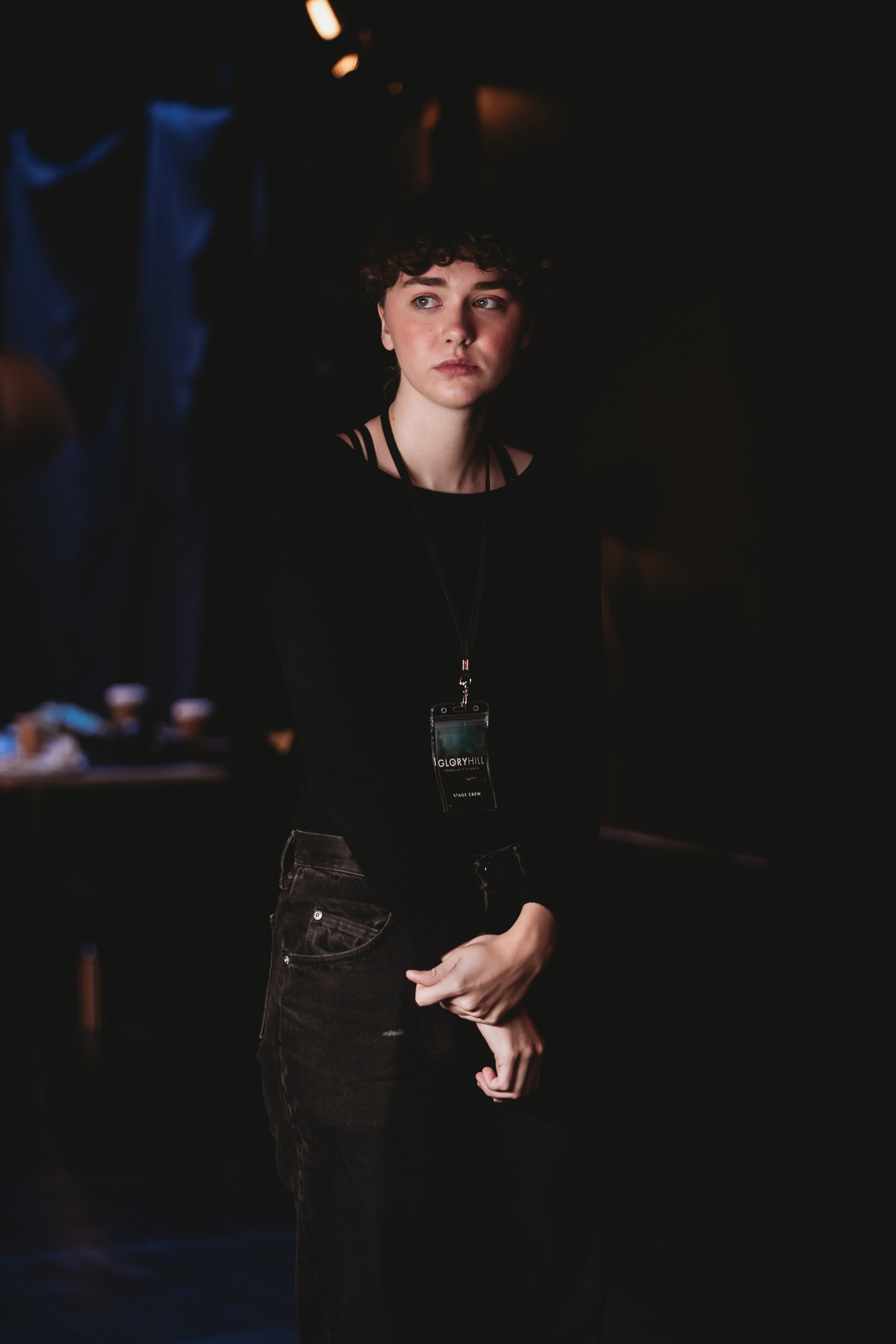
Maggie Robertson, in character. Photo: Jen Froese
Can you elaborate on this trilogy? I did find it interesting that the film almost had an episodic feel to it. This really felt like we were continuing a story.
When I started, at age 18 and I was melding Kirkegaard with giving myself an intensive film education, I found some lists and suddenly I was watching all the films by Ingmar Bergman and Kieślowski, his “Three Colors” trilogy, and suddenly really liking trilogies from these European filmmakers. Bergman actually has a trilogy that is known as “The Faith Trilogy,” I think he decided to call it that, and so I think I decided, what would be within my means would be to do my own little faith trilogy to kind of source out some of the things I'm thinking about. But in a way that I could maybe actually accomplish, which would be short films instead of a feature film trilogy.
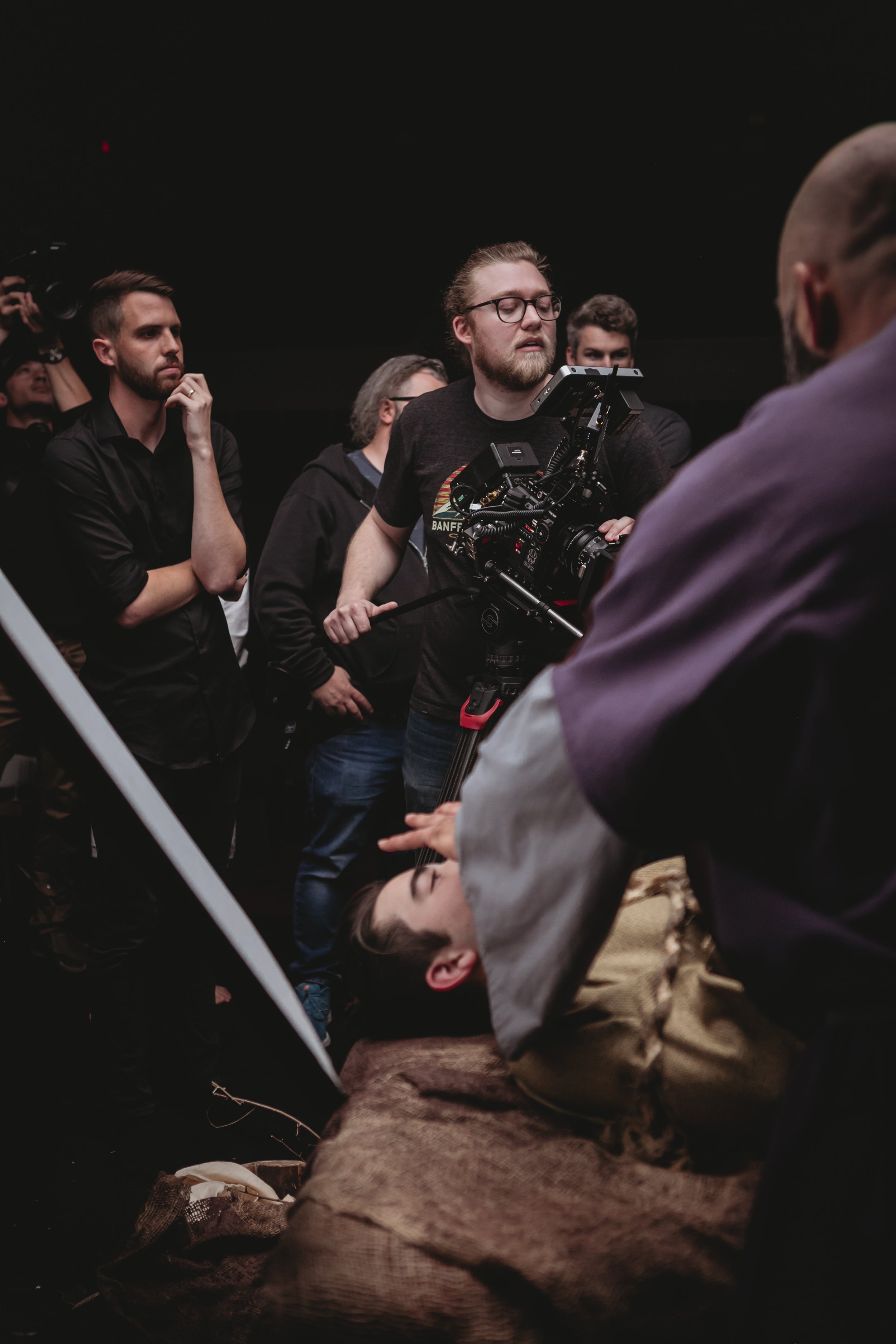
Jeremy Ratzlaff (left) and Jason Rister (centre) frame a shot. Photo: Jen Froese
The opening long-take, Steadicaming through the theatrical dress rehearsal, felt very evocative of the opening to Boogie Nights (1997), Paul Thomas Anderson's film. Could you talk about any of your other cinematic inspirations for this work?
Oh, Magnolia (Paul Thomas Anderson, 1999), one hundred percent. It was my favourite film when I was [18]. I would show it to everyone and sit there as people fell asleep to it, then I’d be like, “Oh, man, people aren’t getting it. It’s such a good movie." Since then, I've met people who also really appreciate that movie. Something about Magnolia did it for me.
To be totally frank, I'm glad it's fun when people notice that I know other filmmakers notice [the Steadicam shot]. But I think it's gimmicky. And I wish I had never done it. I remember suggesting it like, “What if?” to Jason Rister, the cinematographer, and of course, his eyes go big. And he's like, “Yeah, we can do it,” and I fed off that positive energy. I was like, okay, cool, everyone's gonna have fun doing this. It's severely limiting, because we only spent half a day and that was pushing it on this stupid, elaborate shot. Of course, there's no perfect take, and in the edit, you realize there's nothing to cut away to, because that was it, we put all our eggs in that basket. So I had that experience full on where I first looked at the rough cut and and wanted to vomit and never show it to anyone because that needed another whole day of takes to try to massage and get it where we would have wanted it.
What other lessons did you take from this production?
The practical, simple ones are just: more collaboration in pre-production. Because I was too saturated and guilty the whole time I was doing this thing. I mean, it was taking me away from my partner, my other responsibilities in life.I knew how much of a commitment I was requiring from the many cast and crew that I was bringing on to this thing. So I think probably out of that guilt, or just immaturity and need to want to control things, I did pre-production exclusively alone, which was awful, and clearly shows in all the things that fell short when we were doing it. When suddenly Bernadette Mullen, one of the most talented actresses I've worked with, is sitting there rightly frustrated because she was called at the beginning of a day that she wasn't needed until right at the end and sat there all day. Things like that are of course what stand out to me. Our first AD team needed radios, and I didn't get radios for some reason. Stuff like that.
Do you feel this is connected in any way to shooting in Moose Jaw? Moose Jaw doesn't exactly have the strongest production base. I wonder if you could talk about how you pulled this production together because that unto itself seems like no small feat.
It truly felt like Saskatchewan production. Yeah, Moose Jaw obviously has nobody.
Except you.
(Laughs) Saskatchewan as a whole, as we know, is lacking for ready made resources and facilities and foundations to do stuff like this. I mean, our equipment came from, like 10 different places. Then we had a little test screening with a great turnout, and I put our five main actors on the stage, and I realized we were representing five different municipalities in Saskatchewan: Yorkton, Weyburn, Saskatoon, Regina, Prince Albert. That's where our actors came from and we had actors and crew from all over the province.
So the conversations I've been having, because now I've gotten to go to a couple film festivals where Fear & Trembling is screened and done really well and ignited great conversations with other filmmakers about what it was like. And it felt like we really pulled the most that we could out of the province’s resources.
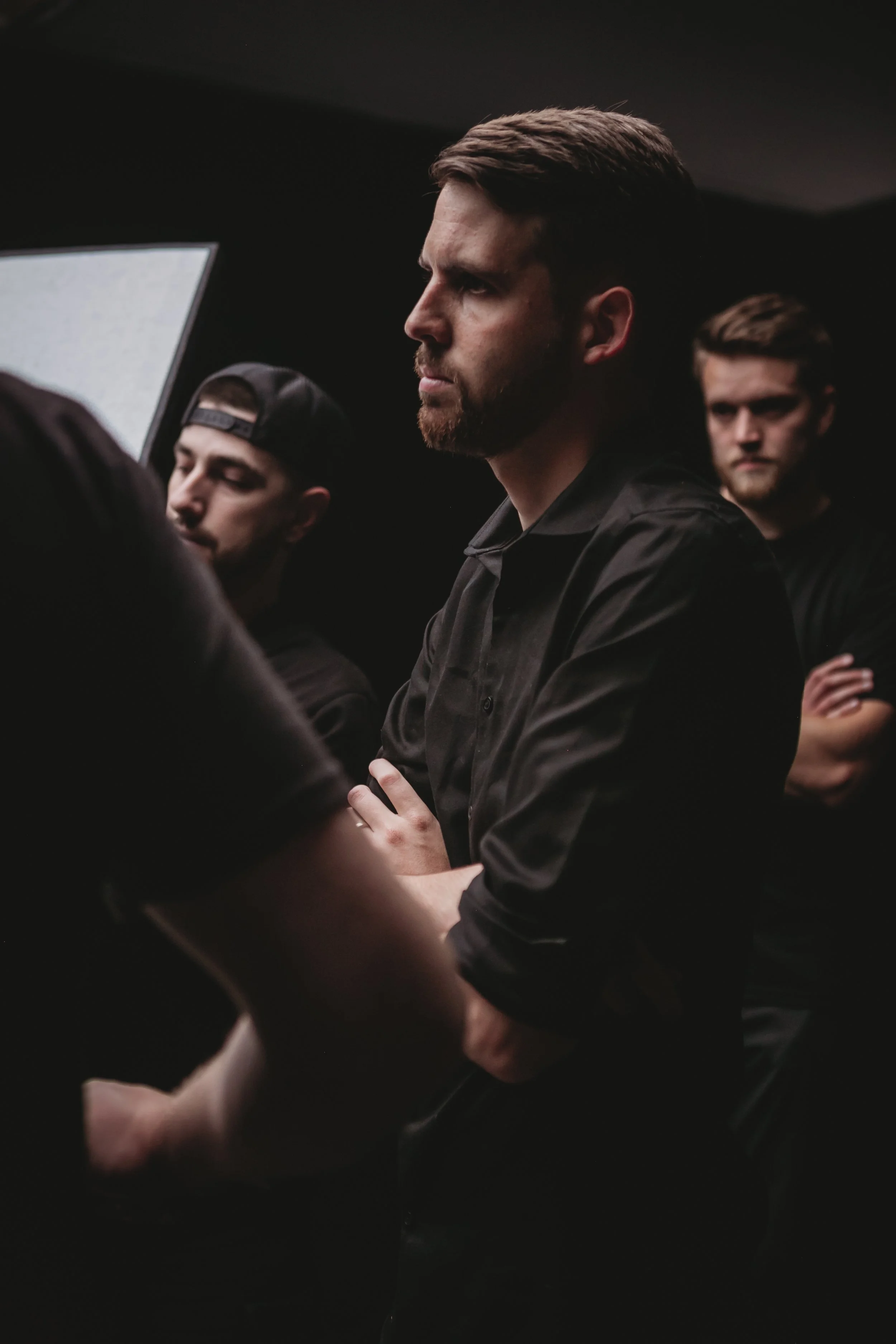
Jeremy Ratzlaff focused on set. Photo: Jen Froese
How did you finance the film?
Self-funded. I had this urgency that was probably unnecessary, or maybe necessary, this urgency that okay, I had a couple good years with my little commercial business in Moose Jaw, working in Regina, and people have given me a lot. They've given me opportunities and I've gotten paycheques from doing cinematography for other people's projects. I wanted to just kind of take it all and give it back, because I'm not a good business person. And so I spent way too much money. (Laughs)
You're a very frank interviewee, I have to say.
Well, I'm not good at money. And so the only way I know how to deal with it is to be sort of frank about it. I have great admiration for peers, fellow filmmakers who self-finance things because I think it is necessary for a lot of visions because there aren't structures in place to support a lot of very genuine, need-to-be-realized visions, and I also think everyone should get paid. So I have good friends whose visions I really support and want to see happen. I support them by funding their stuff. I think we all should do that and need to do that to some extent. But it's not sustainable.
Jumping away from your directing and producing for a moment. Can you tell me a little bit more about some of the projects you've been shooting lately? I know Treaty Road has been a major production in the Treaty 4 filmmaking landscape. Could you speak to that or anything else that's exciting you?
One hundred percent. Meeting and working with the Three Story Pictures producers, thanks to Candy Fox, who gave me the best gift of my career and life. Honestly, by seeing something in my early work with artists that she liked recommended me to for this demo for a show that these producers were working on. Just from a business standpoint, I would have been in trouble if Treaty Road hadn't gotten picked up and greenlit and started shooting immediately after I finished shooting Fear and Trembling. Because I had no control of the budget and could not afford what we were doing, entirely out of pocket. And if Treaty Road hadn't suddenly happened? I don't know.
From a personal level, oh my gosh. I mean, it opened up obviously an entire world of not knowing what we don't know. But the opportunities and the days spent talking to people across six different treaties, and territories and elders and lawyers and legal people and people who filled in so many pieces of the story. T The statement that was said by multiple people that we talked to on how we are all treaty people. I mean, that just became more real to me than it had when I had just been kind of growing up in Moose Jaw and Evangelical Church contexts. That never, never gave me that narrative. I can't speak highly enough of this show and of Candy Fox’s direction of it; Saxon de Cocq as a host; Erin Goodpipe as a host, and the chemistry that they found. I'm so excited for people to see it. Oh my goodness.
Fear & Trembling is nominated for several Saskatchewan Independent Film Awards (SIFA) this year. We still don't know the results at the time of this interview. But what did these nominations mean for you? What does SIFA mean for you? And what do you think it means for Saskatchewan filmmaking?
My first thought is, what it means is there's a new crop of people, collaborators and friends that I can now introduce to SIFA that hadn't previously been familiar with SIFA, because for the eight years that I've been here that's been my favourite night of the year. I've done my best to always call people that have just been from other circles into this wonderful opportunity to celebrate Saskatchewan independent film. And there are a handful of other awards, but, this is the night.
So I was really excited when I saw [this year’s] nominations because yes, that's a whole new crop of people that I can introduce to this night and to this event, and to the Filmpool. I'm so grateful that SIFA has been something that's continued even though I know how much work it is with a small staff, but there's a whole lot of passion that's evident every year. I remember feeling impressed and proud of the Filmpool during the first COVID years when they found a way to do it virtually; they've always done a great job finding their hosts and it always feels like the warmest little night; the collection of everyone that's worked on each other's films. Yeah, it gives me all kinds of fuzzies.
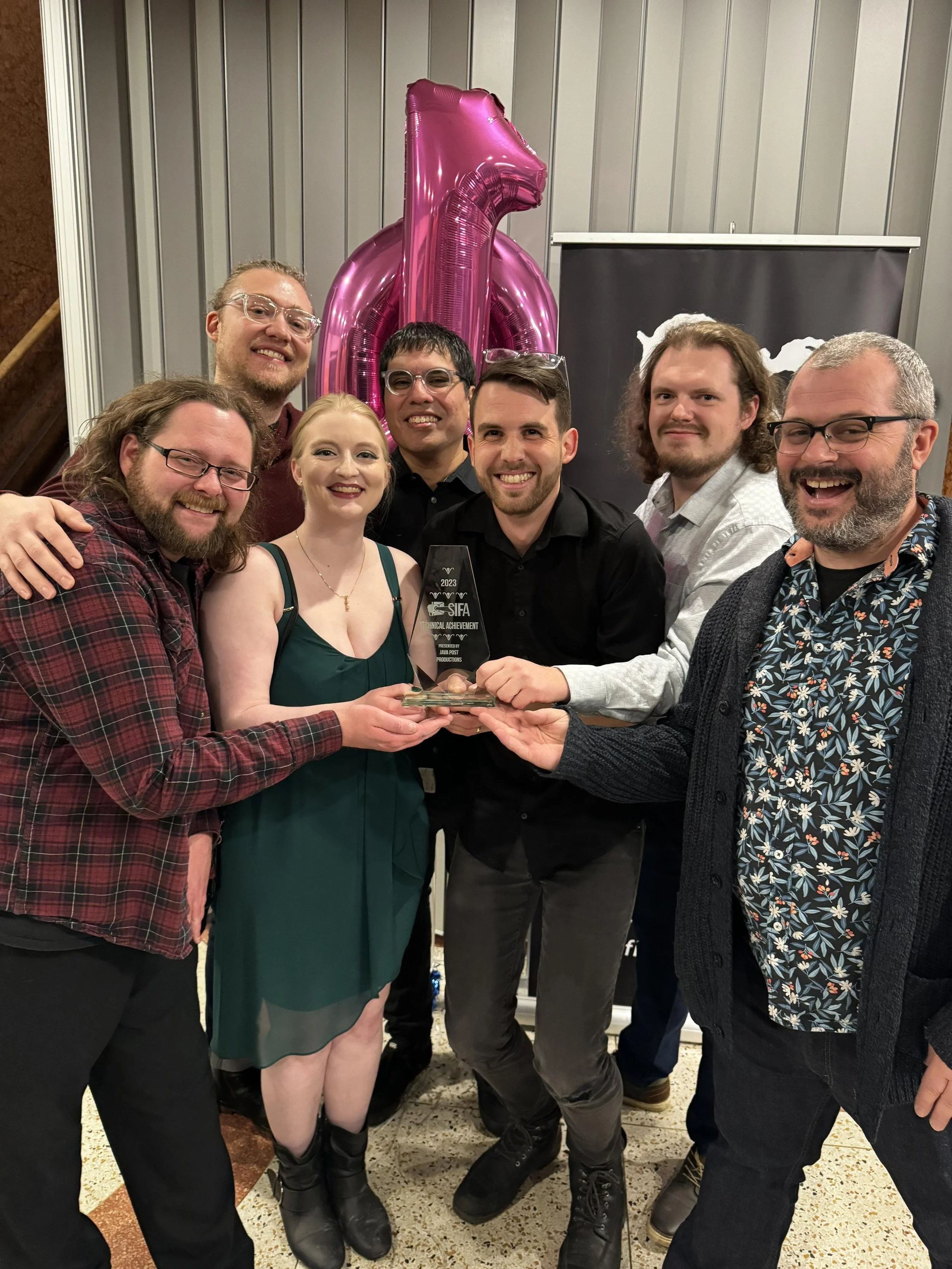
SIFA 2023. L-R: Kyle Parkinson, Jason Rister, Laura Psotka, David Roman, Jeremy Ratzlaff, Curtis McGillvray, Ben Schubert. Source: Jeremy Ratzlaff
Is there anything you want to see more of in the future of prairie filmmaking?
I mean, certainly more conversation that's weaved into an awareness of Treaty. And that's not just talking about Indigenous filmmaking, that's got to apply to filmmakers of all backgrounds. I want to check any ideas that I might have in the future, or projects that are inviting me to kind of come on board, check how this weaves into the story of the land and the history of the land that it takes place on. That’s the narrative. I didn't have a solid sense of identity or narrative or purpose and it's something I still struggle with but it's engaging with the privilege of whatever background you came from and then the context and the reality of today and our neighbours and our communities. That's gotta be it. That’s got to be the way to get anywhere authentic and create any new stories or new content that has any value to contribute.
Is there anything you want to say to the other SIFA nominees?
Oh my goodness. I mean, to tie it beyond my own little arc that I've created here in this time we've had together, inspiration and creativity is very much a flame that gets passed along. I know there are brilliant artists out there that can just sort of, you know, emerge brilliant things from a bubble. That's never been me. The joy that I found in working on things and creating things and helping support things has been the joy of community and collaboration. Especially through really darker times or slower times or poor mental health times. That's never been more true. I know film is business. But the flame, and the life, is that of the many artists that have inspired me over the last eight years. Chrystene Ells, Berny Hi, Candy Fox, Mattias Graham, Lucas Frison, Kelly-Anne Riess, Curtis McGillivray, Aaron Sinclair. These are really great Saskatchewan filmmakers that have owned this as their home and told stories as authentically as they could and formed a community. It's not about the film that comes out at the end. It's about the community that was involved in the making of it.
Beautifully put. One final, quick question: in Fear & Trembling, was the goat pooping planned?
One hundred percent. It was in the script. I think what I told everyone was, “Okay, here's what we're going to do. We're going to set up this camera pointing in the right direction. We'll get the frame. And then we'll give it 20 minutes. And if we don't get it in 20 minutes, we're moving on,
we'll let it go.” We got buckets full of urine first, which the stage manager was not happy with. And then we finally got the moment. I vividly remember looking over at Jason Rister who was quickly readjusting the camera. There's a lot of goat defecation footage that we were so fortunate to get. RIP Penny [the goat] who passed shortly after we filmed, but who was pretty lovely to work with.
Immortalized, now, in Fear & Trembling.
Yes [the owner] Mandy Bender and her daughter, they showed up at the screening. They've been such huge supporters of the film because they recognize that Penny is immortalized in that project.
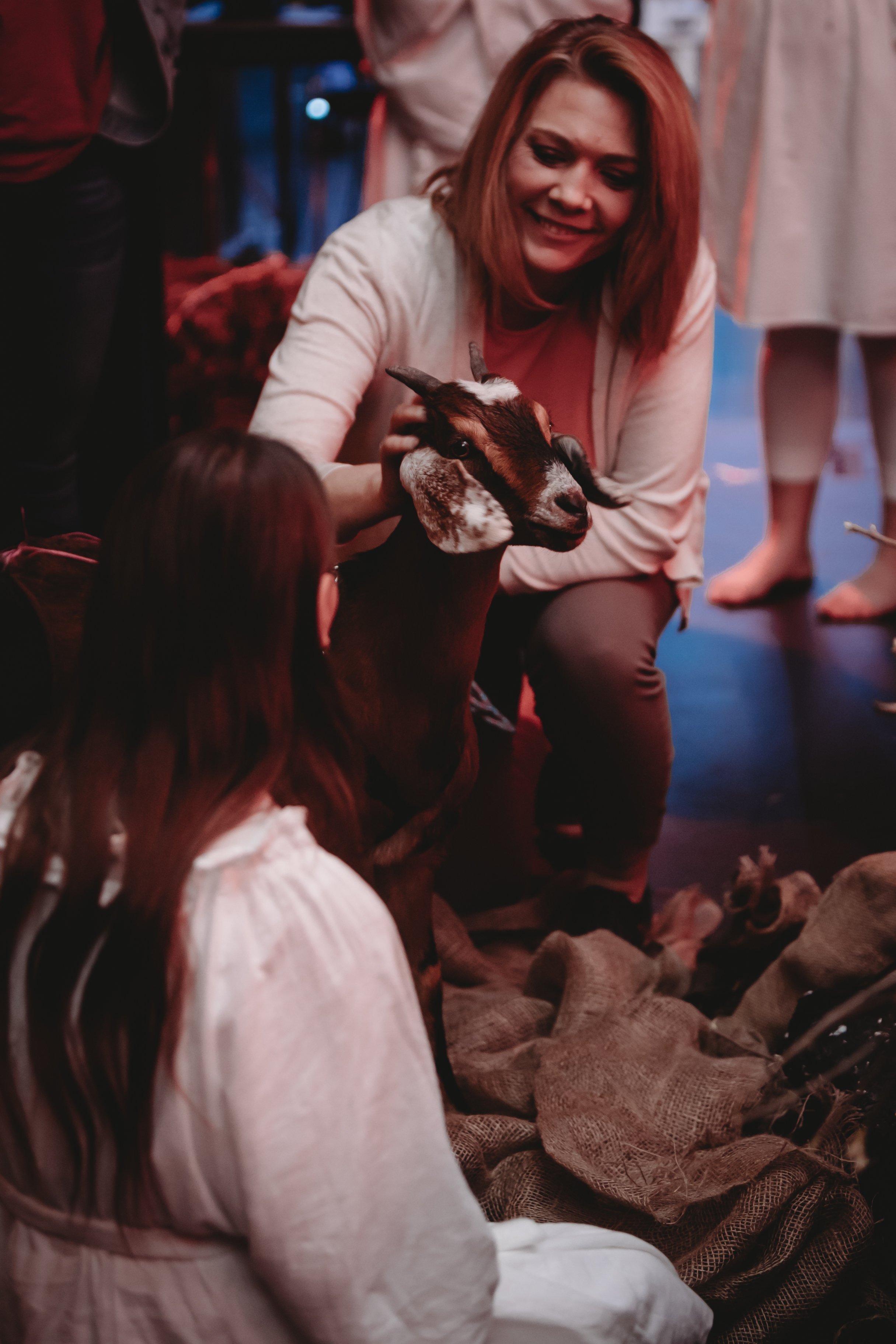
Bernadette Mullen & Penny the goat. (Photography: Jen Froese)
RIP Penny. And thank you so much for your time today, Jeremy.
Thank you so much.